4 A survey of key work published in China on the 1911 revolution in the decade 2000-09 is Kaiyuan, Zhang and Tong, Tian, " Xin shiji zhi chu de Xinhai geming shi yanjiu " ("Research on the Xinhai revolution at the start of the new century"), Zhejiang shehui kexue, No. 9 (2010), pp. 89 - 98 Google Scholar. The aftermath of the. The first revolution, in 1911, aimed to rid the country of the Manchus and to set up a republic modeled on the governments of the United States and Great Britain. It was comparatively simple to overthrow the Manchu Dynasty. It fell because it was too rotten to stand. 
PPT Chapter 22 Section 2 Revolution in China PowerPoint
Another defeat for the Qing results in a treaty forcing the legalisation of opium and Christianity. This humiliating defeat gives rise to the Self Strengthening Movement, an attempt to industrialise China and increase her capacity for self-defence.. "Chinese Revolution timeline: to 1911, Alpha History, accessed [today's date], https. The Cambridge History of China, Late Ch'ing 1800-1991,Volume 2 3. Jean Chesneaux, Marianne Bastid, and Marie-Claire Bergere, China from the Opium Wars to the 1911 Revolution 4. John K. Fairbank, The Great Chinese Revolution, 5. Arif Dirlik & Roxann Prazniak, The 1911 Revolution: An end and a beginning
The Chinese Revolution of 1911 In October of 1911, a group of revolutionaries in southern China led a successful revolt against the Qing Dynasty, establishing in its place the Republic of China and ending the imperial system. Photograph of Revolutionaries in Shanghai The first phase of the Chinese Revolution started with the republican revolution of 1911, which came about as a result of growing social unrest, the disruptive and humiliating presence of Western and Japanese troops on Chinese soil, and the inability of the imperial government to launch the process of China ' s belated modernization or even to. 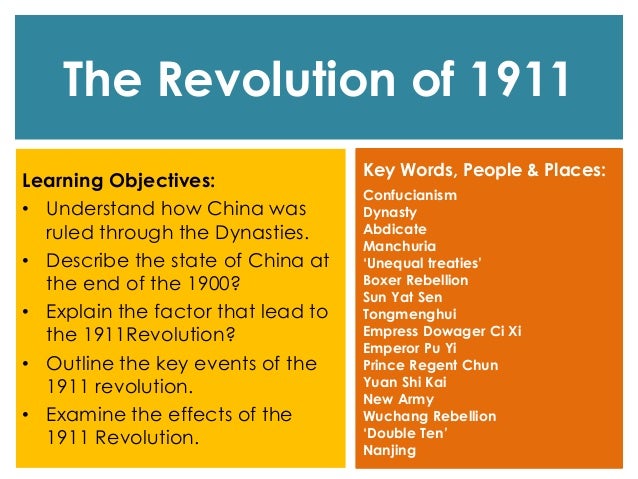
China Pre 1911
The Xinhai Revolution took place in China in 1911, bringing an end to China's last imperial dynasty. According to the Chinese calendar, 1911 was the year of the Xinhai, which means. The history of the Xinhai Revolution began with the Wuchang Uprising, an armed rebellion against the Qing Dynasty rulers that broke out on October 10, 1911, in today's Wuchang District, Wuhan City, central China's Hubei Province. After Wuchang was taken, the revolutionaries quickly seized strategic locations Hanyang and Hankou, altogether known.
Before the 1997 CPC National Congress, it was believed that the greatest historic achievement of the 1911 Revolution was that it overthrew the decadent Qing Dynasty (1644-1911), ended the 2,000-year-old autocratic monarchy and established the first bourgeois republic in China. The revolution was named Xinhai (Hsin-hai) because it occurred in 1911, the year of the Xinhai stem-branch in the sexagenary cycle of the Chinese calendar. The revolution consisted of many revolts and uprisings. The turning point was the Wuchang uprising on 10 October 1911, which was the result of the mishandling of the Railway Protection Movement. 
1911 Revolution Wikipedia
The Wuchang Uprising was an armed rebellion against the ruling Qing dynasty that took place in Wuchang (now Wuchang District of Wuhan), Hubei, China on 10 October 1911, beginning the Xinhai Revolution that successfully overthrew China's last imperial dynasty. It was led by elements of the New Army, influenced by revolutionary ideas from Tongmenghui. The uprising and the eventual revolution. The Chinese Revolution (1911-12) Li Yuanhong The Chinese Revolution was triggered not by the United League itself but by the army troops in Hubei who were urged on by the local revolutionary bodies not incorporated in the league.
In 1910, the Chinese Empire reasserted itself and occupied Tibet. However, this would be the decadent Empire's last triumph. All across China, revolutionary groups had formed to overthrow the regime, with one such group managing to seize power in the city of Wuchang on October 10, 1911. From there the revolution spread quickly, and, in January 1912, China was declared a republic. Revolutionary origins The 1911 Revolution had seemingly benign origins, beginning with disputes and protests over railway ownership in Sichuan province and surrounding areas. The flashpoint for revolution came in October when a republican-minded army unit mutinied in Wuchang, Hubei province.

Chinese Revolution or Xinhai Revolution Soldiers of the Chinese
The revolution started 110 years ago and saw the end of the Qing dynasty and the birth of a new China 1,000 year old social system. 4,000 year old monarchy. Causes of the Revolution of 1911. 1) Elite politics with widespread support, against: 250 year old Qing Dynasty. 1,000 year old social system. 4,000 year old monarchy. 2) Corrupt and inefficient government. 3) Foreign intervention.